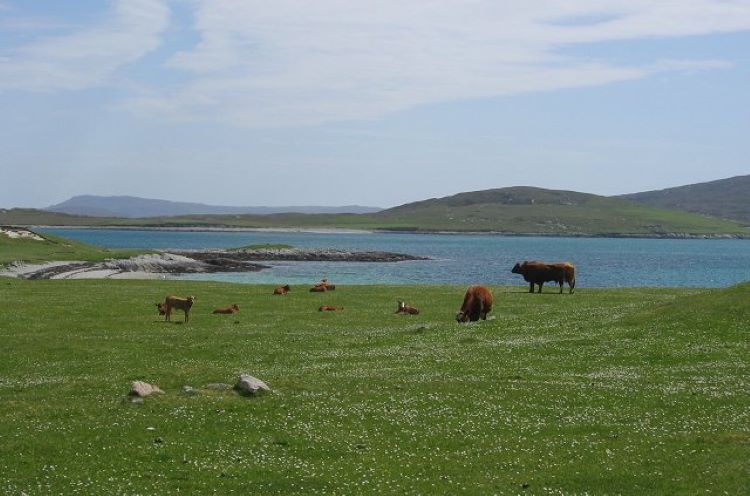
Image: The Machair on Berneray, Outer Hebrides, By Richard Webb, CC BY-SA 2.0.
Soundyngs is interested in different approaches to history-telling: written narrative is time-tested, but recordings which are curated in ways that highlight different themes are also useful and includes both public archives and commercial record companies.
Sound archives are often simply quoted or inset as part of a linear historical narrative.
However, more creative use of this material can represent histories in more complex, less linear, ways, freeing the imagination to consider links between present and past sensory knowledge.
Soundscapes in contemporary composition have a range of possible uses, including contributing to a multisensory experience in an art gallery or museum which brings the past alive. Extracting sounds from the archives and mixing these into new compositions can also add past ethnographic witness to power new works: I’m thinking here of Martyn and Margaret Bennett’s ‘Glen Lyon’ album (2002), which mixed together archive recordings representing Martyn and Margaret’s Gaelic heritage with material from diasporic Scots who emigrated to North America, weaving a multi-layered reflection on the dispersal of historic Gaelic culture to new places.
I was reminded of the power of sound art to reimagine the past by a talk (17 July 2026) hosted by the Glasgow School of Art, from sound artist Cathy Lane, Emeritus Professor of Sound Arts at the University of the Arts in London, on her use of audio archives. Lane’s work combines archive material, field recordings, spoken word, music, and electronic sounds: in her talk, she described these sources as providing ‘different kinds of traces’ able to transmit different kinds of knowledge, showing different ways of telling stories.
Soundyngs readers will be particular interested in listening to Lane’s Hebrides Suite (2008), which comprises 6 tracks combining archival sound material with new interviews, songs, stories, and simply field recordings of sounds associated with Uists. To make this, Lane drew on many different archive sources, including the rich holdings of the School of Scottish Studies at the University of Edinburgh.
- Sea Shanty 8’132
- On the Machair 10’03”
- Tweed 11’00”
- Gaoth (Wind) 9’59”
- Where Once Were Whales 12’02”
- Watch Over Us All 12’00”
The opening track – ‘Sea Shanty’ – provides sound from the on-boarding announcements of CalMac ferries at Oban. I could almost smell the diesel.
The second track, ‘On the Machair’, evokes the unique low-lying farmland of the Outer Hebrides, particularly of North Uist. This track combined archive and field recordings of residents, birds (listen for the iconic and rare corncrake), sea, and animals, at work and play, including an accordion at a beach party. In a 2011 article in Shima: The International Journal of Research into Island Cultures, Lane explained that the ordering of sounds within the track starts with the sea (herring fishing was historically critical to the fortunes of the community), moves to sheep (the arrival of which was associated with clearance emigration), and then kelp gathering (Lane, 2011, p.123).
The third track is ‘Tweed’, a meditation on sheep, wool, and cloth, featuring the voice of Harris weaver Catherine Campbell. Lane describes this movement as a ‘fantasie’ (Lane, 2011, p.123) on the voices of people involved in this industry “in a specific time and place”: Campbell’s weaving shed at Plocrapool in Harris. Campbell’s business at this location closed down shortly after the composition was made, so this is a historic remnant of activity no longer present at this place.
The fifth track, ‘Where Once Were Whales’, considers the importance of the whaling industry and fishing more generally to Hebridean communities. The location featured is Bunavoneadar, in the past, a whaling station in Harris set up by Lord Leverhulme to provide an alternative employment to crofting. Whales are (thankfully) no longer fished here, but the track considers inshore fishing – lobster, crabs and shellfish – which is still important to the local community.
Lane’s 2011 article on the project is an interesting read, citing both ethnographic theory and the work of other sound composers such as Hildegard Westerkamp to make a case for sound art as a kind of ‘docu-music’ (Lane, 2011, p.124).
Creative projects like these help to encourage active ways to explore and express local histoies, which can be particularly useful in community outreach work. In 2015, the Hebrides Suite was used to frame a local education project and exhibition at the Museum nan Eilean in Benbecula, encouraging further creative work. Local groups including school children and local community history groups were invited to map their own remembered places, and to accompany Lane while she recorded new sounds associated with these sites.
Cathy’s work is like a radio tuned to multiple channels – the sound of sea, Gaelic voices overlapping, English commentary, Cathy’s own commentaries, bird song (the unmistakable sound of curlews and corncrakes), the distance baas of sheep, an accordion playing dance music: these come in overlapping waves, tumbling over each other. This method of history-telling is not linear, as a book might be: it overlays the past with the present in ways that look for resonances and echoes. The implication is that history cannot be told from only one point of view: it emerges from the interplay of different sounds, human, animal, and elemental.
Cathy’s July 2026 talk included reflections on the ethical dimensions of her creative process. She considers archive recordings to be a kind of field recording – open to being edited and “played with” for creative use – and was thoughtful about the necessary ‘reverence’ needed for historical use.
Finally, Lane’s talk in July 2026 mentioned the archives of the North Uist Historical Society, Comann Eachdraidh Uibhist a Tuath (CEUT) as an additional source worth exploring. This archive, maintained by volunteers, has built up a rich collection of local material to help conserve their local history (see CEUT, in further listening and reading). The archive contents continue to shape exhibitions and talks at the Taigh Chearsabhagh Museum and Arts Centre at Lochmaddy, North Uist (this summer’s exhibition features the Sound of the Sea, connected with a research project on the science of fluid mechanics).
This is interesting, thought-provoking work. As machines begin to generate written histories, sound art may well provide another route to gathering and sharing complex local histories.
Cathy Lane’s research profile is here and she can be contacted at [email protected]
Further Reading and Listening
- Martyn Bennett, with Margaret Bennett, Glen Lyon: A Song Cycle (Foot Stompin’ Records, 2002)
- Cathy Lane website
- Cathy Lane, The Hebrides Suite CD description and acknowledgements, and retail website
- Cathy Lane, ‘On the Machair’ website and on Soundcloud
- Cathy Lane. ‘Tweed’ website and on Soundcloud
- Cathy Lane, ‘Where Once Were Whales’ website and on Soundcloud
- Cathy Lane, ‘The Hebrides Suite: mapping the islands in sound at Museum nan Eilean, Isle of Benbecula, Outer Hebrides, Scotland’, 30/7/2015, blogpost accessed 20/7/26
- Cathy Lane, ‘Listening for the Past: A composer’s ear-lead approach to exploring island culture past and present in the Outer Hebrides’, in Shima Journal 5(1), (2011), pp.114-127,
- CEUT (Comann Eachdraidh Uibhist a Tuath) sound archive
- Museum nan Eilean Lionacleit, Benbecula website
- Taugh Chearsabhagh Museum and Arts Centre, Lochmaddy, North Uist website