
Although the design has changed over the centuries, from the 18th century onwards Scottish luthiers have embraced the Italian violin and professional makers have striven to rival the finest of European makers. However, Scots have also made fiddles using a creative range of materials.
People may talk about having a tin ear, but the Stromness Museum has a curious fiddle with a wooden neck and a tin body. Like many islanders, maker James Scarth Foubister had more than one string to his bow, owning a fishing boat in addition to working as a blacksmith. He made his tin fiddle hoping that it could more readily withstand the hurly burly of being played at sea, having seen several instruments smashed during heavy weather.
At least one performance on this instrument in recent years has given listeners the chance to hear what this instrument sounds like. Following the Fleet: Drifters (2016) was performed during the Orkney International Science Festival, a film about the herring industry followed by story-telling, and poetry reading, during which local fiddler James Watson gave the tin fiddle an outing. The Museum has a short youtube video on this instrument.
A similar instrument is discussed by the Vermont Historical Society, built in the early years of the 20th century. Its maker, Forrest Gray, was a keen amateur folk fiddler in the North American town of East Calais, and the video describes him as a ‘general tinker’ and rough metalworker.
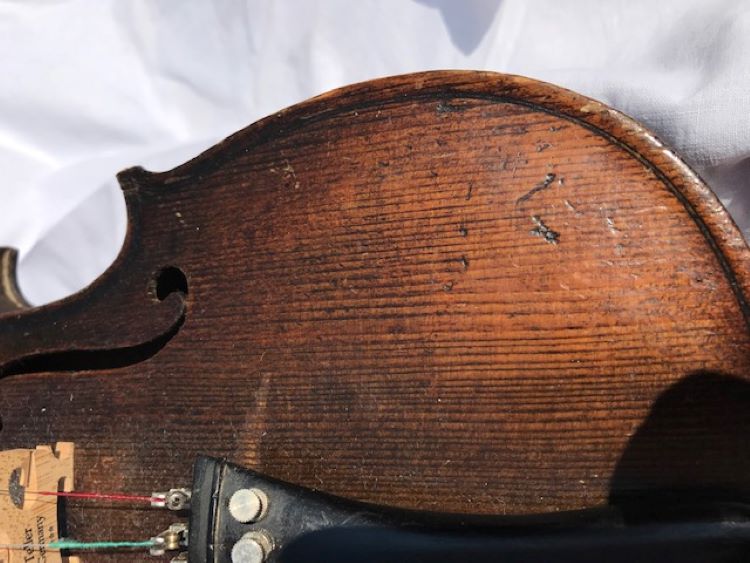
Instruments like these were obviously made by self-taught player-practitioners rather than professionally-trained professional luthiers, although Scotland also had these. References to Scottish professional makers are scattered through a lot of sources: Mary Anne Alburger’s Scottish Fiddlers and their Music (1983) for example, mentions people like Matthew Hardie (1755-1826) of Edinburgh (p.118). In addition to commercial luthiers like Hardie, Scotland also had a large number of self-taught craftspeople. My niece has a fiddle gifted to my father when an elderly friend died (see featured photograph), which we think (from family anecdote) was made in Caithness probably in the 1950s or 60s, using fairly grainy pine and sycamore. Someone in the maker’s workshop had stuck a note inside to say it was a Stradivarius and “made in Germany” (written in English).*
A survey of professional / commercial Scottish violin makers was made by William Honeyman at the end of the 19th century, and although this work is now out of print, it is still available to Kindle users as digital copy. Honeyman, originally from New Zealand, lived and worked as a violin teacher in Edinburgh and then Newport, Fife, where he lived in the appositely named “Cremona Villa” (named after an illustrious Italian violin dynasty). His work reveals a painstaking fascination with historic fiddling and should be consulted by anyone interested in this topic. Particular strengths are makers in the east and north-east of Scotland, reflecting Honeyman’s own social networks. However, there is room for a research program that updates this work, including a survey of any known records of amateur makers, and definitely a survey that includes much more information on making in the Western isles and far North. Honeyman highlights an Orcadian maker, James Omond, of Stromness, whose work Honeyman judges to be “decidedly above average”. If anyone reading this knows of more recent surveys please note in the comments.
European classical musicians rightly prize fine-grained and smoothly varnished craftsmanship in a fiddle, but in other world traditions, rougher grained timbres (and indeed timbers) form part of the vernacular aesthetic. What sounds rough in the concert hall is sometimes ideal to accompany the stomping of feet dancing in a hall; the more open grain gives the instrument a bit of bite and percussive edge. Amateur makers and their instruments are an uncharted ocean.
*Updated 5 August 2026 – a conversation with Thurso man Jack Sinclair suggests that my family’s fiddle might have been made by his father-in-law Willie Gibson (d.1986). He remembers printing the ‘Stradivarius’ labels on a very early computer!
Further Reading
- Mary Anne Alburger, Scottish Fiddlers and their Music (London: Victor Gollancz, 1983)
- William C Honeyman, Scottish Violin Makers: Past and Present (2nd edition 1910) (Edinburgh: E Kohler, 1899)
Very interesting blog post. Reminds me of similar instruments in the Donegal fiddle tradition, including a brass fiddle made and played by brothers Frank and John Cassidy and tin fiddles made by the Doherty family (legendary fiddler Johnny Doherty was a traveling tinsmith). Some fascinating parallels, especially considering the deep connections between the Donegal and Scottish fiddle traditions. Some links on the tin and brass fiddles in Donegal:
https://donegalfiddlemusic.ie/john-cassidy-1886-1924/
https://boxandfiddlearchive.weebly.com/metal-fiddle-tradition-in-donegal.html
https://donegalfiddlemusic.ie/history/
Thank you Jack – that’s really interesting follow up material. The Edinburgh University https://www.tobarandualchais.co.uk/ archive has a lot of sound recordings of song material from the Scottish Traveller community, but interesting that the itinerant tinkers – who had metal expertise – clearly also had a line in fiddling both in Ireland and Scotland.