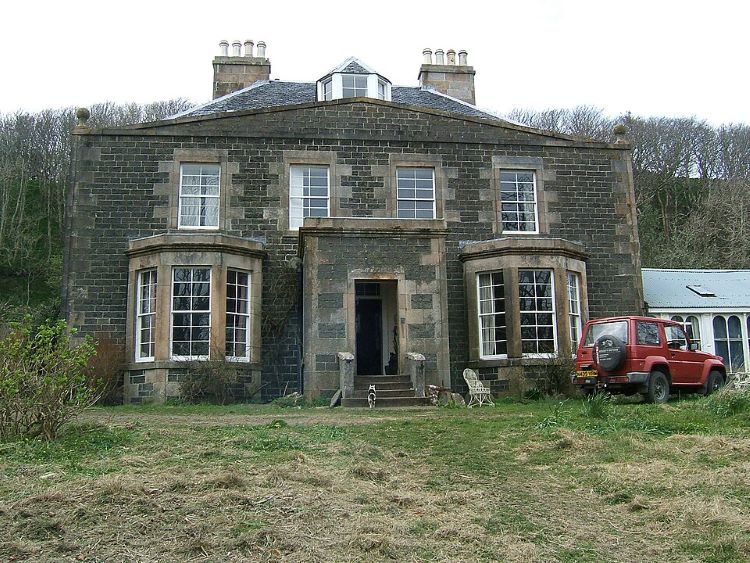
Image: Canna House before refurbishment, Peter Van den Bossche, CC BY-SA 2.0, via Wikimedia Commons
The National Trust for Scotland have recently announced that Canna House has been reopened following a 9 year closure for much-needed renovation. As of this moment, the archive is still not fully accessible for research, although the NTS is inviting enquiries so hopefully this will change sometime in the future. One suspects the issues here are staffing and also possibly footfall (Canna is not one of the easier Scottish islands to reach).
Some archives sit in urban centres. Not this one. Canna is the most westerly of the Small Isles (also known as the Inner Hebrides), accessible by boat. Well, in theory. I nearly got there some years back on a sail boat, but rough seas turned me back. For the more timid sailor, I’d advise the CalMac ferry from Mallaig as a (slightly) more reliable alternative: other options are available according to the island community website.
Canna’s scenery and wildlife is also fascinating, but what particularly interests us here are the musical riches potentially in store for visitors, and what the house can tell us about 20th century song collecting.
From 1938, Canna was owned by John Lorne Campbell, who lived there with his wife Margaret Fay Shaw. Both were accomplished ethnographers, although working as independent scholars, their collections are not fully knitted into the institutional curations of national libraries or universities. In 1981, Campbell gifted the island and its contents – including a singular collection of Gaelic literature and folk song – to the National Trust of Scotland, although with stipulations that the archives should be held in the house. Both he and Margaret continued to live in the house until their deaths. Since 2017, a community trust has also been involved in running island infrastructure.
The National Trust has a treasure here – but possibly, with terms attached that make full access and robust curation of the archive less than straightforward.
John Lorne Campbell and Margaret Fay Shaw
John Lorne Campbell (1906-1996) grew up in comfortable circumstances in Inverneill House on Loch Fyne, Argyll, and took a degree in Rural Economy with Celtic Studies at Oxford. As a young man in the 1920s, he lived through the early years of the Scottish literary renaissance and began to take an interest in how this “revival” might apply to Gaelic Scotland. Working with folklorist Professor John Fraser, he applied himself to study Gaelic song, initially working with the printed resources of the Bodleian and the British Museum. From these early contacts with the printed collections, he began to understand that culturally dominant lowland descriptions misrepresented Gaelic culture. Lorne Campbell’s interest in wildlife, particularly insects and birds, also primed his awareness of these themes in Gaelic song and folklore.
The family fortunes were in decline, and the family estate was sold. Moving to Barra in 1933, Lorne Campbell lodged for some time with the writer Compton Mackenzie, began to learn Gaelic more systematically, and become more intimately acquainted with local issues such as fishing, crofting and the sustainability of the island infrastructures.
Margaret Fay Shaw (1903-2004) was born in Pittsburg, Pennsylvania, into a Scots-American family whose fortunes came from steel-making. Both her parents died when she was still a child, and she was raised by an older sister before being sent to boarding school. This seems to have instilled a strong spirit of independence in her. She first came to Scotland for a year abroad to study in Helensburgh St Bride’s School: a formative experience of that time was hearing Marjory Kennedy-Fraser sing English translations of Hebridean song in concert. Shaw would come to understand that Kennedy-Fraser’s arrangements were a long way from the originals, but nevertheless, it’s interesting to consider how these art-song versions for many were a route back into the oral originals.
Shaw played the piano, and while at college in New York University studying music, developed an interest in ethnomusicology. This early training made her aware in a more systematic way that classical music harmonies and notation were not accurate tools in Gaelic music transcription. She returned first to cycle the length of the Hebrides, and decided to settle in South Uist because its remoteness looked promising for further studies.
For six years, Shaw lodged with Mairi and Peigi MacRae in Lochboisdale, and from them learned, and recorded, many songs and stories, later publishing these as Folksongs and Folklore of South Uist (1955), wonderfully illustrated with her own photographs. Shaw’s interest in the importance of women as tradition bearers was particularly helpful to her and her future husband’s work on women’s genres such as waulking songs. Her photographic work is also important and sits alongside the achievement of other 20th century female photographers such as Mary Ethel Muir Donaldson (1876-1958) and Violet Banks (1886-1985) in preserving images from the traditional lifestyle of the Scottish Highlands.
In 1934, Margaret met John Lorne Campbell, who had travelled up to South Uist to talk to her about ethnographic photography. Shaw’s knowledge of music and skill with images complemented perfectly Lorne Campbell’s knowledge of local culture and language: together, they formed a formidable team, dedicated to preserving Gaelic culture. Travelling to Cape Breton, they used wax cylinder recording to study the impact of emigrant Gaelic folk culture on local indigenous first peoples, the Mi’kmaq. Many of their ethnographic recordings are now available through Tobar An Dualchais (see further readings); more, and in particular, the field notes and diaries and letters associated with these studies, remain in the Canna House archives. The involvement of scholars such as Hugh Cheape (Royal Museum of Scotland) has also assisted with cataloging the Canna collections (see Cheape, 2002).
Lorne Campbell and Shaw bought Canna in 1938 and set up house there to practice sustainable farming and environmental management long before these were mainstream, alongside researching Gaelic history and folk culture. Converting to Catholicism in 1946, Lorne Campbell further interested himself in that aspect of Hebridean heritage, including the poetry of Father Allan MacDonald, whose works he particularly sought out and curated. A little after her husband, Shaw also converted, although seemingly also maintained her love for the Protestant hymns of her youth.
[As a side note – Canna historically was a predominantly Catholic island: converted early to Christianity via Iona, and before the Reformation, owned by the Church. Archaeology on the island includes many remains of religious buildings, and a 9th century Celtic cross sits near to the Protestant church dedicated to St Columba.]
Lorne Campbell and Shaw had an arms-length relationship with the mainland institution most associated with the folk revival, the School of Scottish Studies at the University of Edinburgh. They probably felt that Gaelic archives should be held close to source and not on the mainland. They possibly found it hard to create a way to articulate how these independent scholars related to university institutional roles. There may be something that narrates the tensions there, but despite these alignment challenges, work has been done by the School of Scottish studies to help curate the recordings in particular, and their website today holds quite a lot of sound material they recorded. Transcriptions of these recordings was assisted by Francis Collinson, and fed into seminal publications such as Hebridean Folksongs (1969-1981). For those interested in waulking songs (oràn luaidh), the 3-volume of Hebridean Folksongs is essential reading.
Lorne Campbell’s academic writing can be found both in an extensive list of books and in all the leading Scottish journals of his day; Scottish Gaelic Studies, the Scottish Historical Review, the Innes Review (particularly on Gaelic history), Studies Studies, and the Journal of Celtic Studies, inter alia. Margaret Fay Shaw is less widely published, and it took some time for her contribution to the wider curation projects to be fully appreciated. In more recent years, more credit has been given to her role in their joint enterprise, particularly, her photographic work. Private conversations, which may have primed attention, are less easy to document, but it is probably true to say that it took both their perspectives to notice and document the contribution of women in the Gaelic isles as richly as evidently this archive shows.
Canna House Archive and Library
Women continue to be important to the survival of the archive. Margaret Fay Shaw was fortunate in having Magda Sagarzazu as friend and archivist for many years. For some years recently, Canna House had a curator in Fiona Mackenzie who was herself a Gaelic singer and songwriter. Her recordings from the archive can be found on Youtube e.g. her re-recording of Margaret Fay Shaw’s 1955 BBC radio broadcast “Folksongs of South Uist” (see Mackenzie, 2015). Those less familiar with Gaelic song should listen to this. Mackenzie’s Youtube channel helps to illustrate the genres and contexts of this repertoire, using archive field recordings of many songs. Cataloguing and curating Canna House’s huge collection of photographs, books, music transcriptions, letters, diaries, manuscripts and ethnographic recordings will be an ongoing labour of love for the new curatorial NTS team. One day, it might be possible to open the door more widely for scholars wishing to visit.
In addition to documents and recordings, the collection includes early devices used to record song in both Canada and Scotland. The house itself – with Margaret’s piano still present in the living room – gives a vivid sense of 20th century life in the Hebrides.
Scholars of Gaelic culture wishing to research here should contact the curator, Fiona Mackenzie, via the National Trust webpages, in advance of their visit. A summary of what to expect can be found here.
Further Reading and listening
- Canna House archives.
- “Canna House Reopens with Post-War Atmosphere Preserved’. From the National Trust, 13 June 2025, including a short video summarising works and opportunities.
- John Lorne Campbell (ed.), Hebridean Folk Songs, 3 vols (1969-1981). Vol 1 Waulking Songs collected by Donald MacCormick in South Uist, 1893; Vol 2 Waulking Songs from Barra, South Uist, Eriskay and Benbecula; Vol 3 Waulking Songs from Vatersay, Barra, Eriskay, South Uist and Benbecula. Reissued with transcriptions from recordings by Francis Collinson (Edinburgh: Birlinn, 2018)
- John Lorne Campbell, with Hugh Cheape (ed.), Canna: The Story of a Hebridean Island (Edinburgh: Birlinn, 2002)
- Mary McCarthy, ‘Margaret Fay Shaw (1903-2004)’, Folk Music Journal 9(1) (2006): 136-137.
- Mackenzie, Fiona J, Homepage
- Mackenzie, Fiona J, Youtube channel
- Mackenzie, Fiona J, ‘Folksongs of South Uist Broadcast: Margaret Fay Shaw’s Words Read by Fiona J Mackenzie’, on Youtube, re-recorded in 2015.
- Mackenzie, Fiona J, The Cadence of a Song: The Life of Margaret Fay Shaw (Edinburgh: Birlinn, 2025)
- Ray Perman, The man who gave away his island: a life of John Lorne Campbell (Edinburgh: Birlinn, 2013)
- Margaret Fay Shaw, Folksongs and Folklore of South Uist (Routledge and Kegan Paul, 1955)
- Margaret Fay Shaw, From the Alleghenies to the Hebrides: An Autobiography (Edinburgh: Canongate Books, 1993) (now available from Birlinn)
- Solas (2019), a film produced by Fiona J Mackenzie about the life and work of Margaret Fay Show – temporarily on Youtube (and see also the BBC discussion of this film)
- Tobar An Dulchais – recordings by John Lorne Campbell
- Tobar An Dulchais – recordings of Margaret Fay Shaw
The first biography of Margaret Fay Shaw is now available from Birlinn Ltd- “The Cadence of a Song- The Life of Margaret Fay Shaw” by myself, Fiona J Mackenzie. Published 2025.
Thanks Fiona – post amended with this linked into the further reading!