
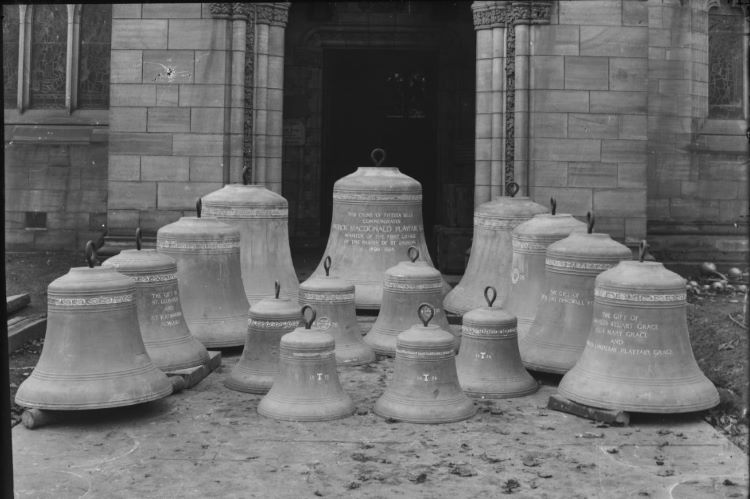
Image: Bells from Holy Trinity Church. A carillon of 15, c1926. Courtesy of the University of St Andrews Libraries and Museums, ID: GMC-F-41 from their George M Cowie Collection, photographer John Fairweather see https://collections.st-andrews.ac.uk/item/bells-holy-trinity-st-andrews/8135
Soundyngs’ last post was about sacred landscapes. This one is on bells – a significant sonic presence in the Scottish landscape in earlier times, and to some at least, part of its musical heritage even today. During Covid lockdown in 2020, the carillon in the featured image to this post regularly provided music thanks to local musician Callum Macleod, who was able to maintain social distancing up in his tower thanks to the hammer mechanism of that particular array. And very cheerful it was too, in those difficult months.
Bells are particularly associated with Christian worship sites, and in pre-Reformed Scotland were rung as a call to prayer to those working in the vicinity of the building. Inside, during the Mass service, handbells sound when the Host is elevated. In monasteries in particular, bell ringing formed part of a daily cycle of services (the Office of the Hours) that connected daily time with sacred time.
The Reformation saw many bells removed and melted down. However, rather to my surprise looking into this topic, I learned that the 17th century saw an uptick in bells rung from church towers and steeples (Clouston, 1992). Bells were also a useful local timekeeping device – but clearly also important to local identity, marking parish boundaries and demanding attention from parishioners even in Reformed Scotland. Research also shows that, outside of worship, in times before ubiquitous clocks, bells fulfilled a useful function in towns to ring in the start of the working day or end of day curfews, and to mark civic events, being often rather more reliable than early clocks (Ditchburn, p.233).
The oldest surviving bells, however, are hand-bells, not rope rung tower bells. Campanophiles may know, and others will welcome, that there have been county surveys of Scottish bells undertaken by the Society of Antiquaries, and interest in bells running all the way back to the first volume of their proceedings in 1852, which included a paper on ancient hand-bells (Wilson, 1852). We learn there, inter alia, of a the handbell originally associated with the church of Strowan in Perthshire. This church and its bell was dedicated to St Fillan, the Celtic saint of wet places and healing streams. According to local legend, any robber seeking to steal this object apparently found it suddenly became very heavy until it had to be dropped or returned. The same article lists quite a few other hand-bells, both extant and of at least historical record, of which the famous bell of St Kentigern of Glasgow is amongst those now lost.
Other essays from the Society of Antiquaries of Scotland continue to take an interest in these early hand bells. Francis Eeles in 1926 gives a useful account of the Guthrie Bell from Guthrie Castel near Forfar. A recent multi-authored paper from 2013 provides a note on the Kilmichael Glassary Bell-Shrine, a quadangular handbell now held by the National Museums of Scotland, which this article (Caldwell et al., 2013) suggests may have been associated with St Columba. Examination of these handbells suggest their designs reflect the early Celtic conversation of Scotland from Ireland.
Early Christianity was not organised in regular parishes as later became the case, but it might be surmised that those attending Mass with a missionary would come to associate this with the sound of particular hand bells.
Monasteries, with communities of monks working around the main buildings, would have used bells to summon people for regular worship. During the middle ages, Scottish parishes became more regularly organised around parish churches, and many of these would had more substantial tower bells in emulation of the monastic communities. The Society of Antiquaries has published county surveys which mention examples of these, including works on the bells of Perthshire, separately on the more substantial bell tradition of St John’s Kirk of Perth, Stirlingshire, Renfrewshire, Dunbartonshire, Aberdeenshire, Wigtownshire, and Kirkcudbright. Ranald W M Clouston is a significant recurrent name in this research, contributing several of these studies.
We learn that larger tower bells – indeed, assemblies of bells – in the later medieval and early modern centuries came typically from continental Europe: particularly Netherlandish places such as Malines in Belgium, or Meddelburg and Rotterdam in the Netherlands (e.g. Clouston, 1992). Howevr, as Scottish iron foundries became more competent in the 19th century, these supplanted continental sources (Clouston, p.456), with Glasgow particularly well set up to supply demand. The Disruption in the Church of Scotland saw more churches built – and rising demand for more bells cast in Scotland for a parish landscape that now peeled with divergent calls to worship.
A final part of the story might be educational establishment bells. Those associated with Universities are/were typically associated with the University chapel. Jane Geddes has a short chapter on ‘The Bells’ in her booklet about Kings College Aberdeen. No less than 13 were originally in the tower, part of Bishop Elphinstone’s original 1505 charter. The same book also has a contribution from John Harper on ‘Music and Ceremonial’ in the first 60 years of Aberdeen’s foundation, with 20 ‘vicars choral’ capable of singing polyphony, and an organist.
School Bells are various, and school buildings all over Scotland show that many had bells, and if there weren’t bells in towers, then there were definitely handbells in the playground (I remember being bell monitor in infants was a significant and sought after duty in the early 1970s). An 1893 article mentions a bell in the Board School of Prestwick being transferred from the old church of Prestwick c1880 to the new board school, as these were being set up in that decade around the country: “tradition says some foreign sailors carried it away one night for a ship’s bell. Some time afterwards, whilst loading at some foreign quay, some Prestwick sailors recognising its sound boarded the foreigner by night and got the bell back again. (Saunders, p.130).
Other than as school bells, decommissioned monastic bells occasionally found other civic uses, such as the 3 bells from Jedburgh Abbey that were used as fire bells for many years in Jedburgh town steeple, one of which had inscriptions showing the original dedication to St Margaret (Saunders, p.130).
There’s clearly a great deal more that could be said about bells. But I’d better stop before the bats start to gather in my mental belfry.
Further Reading
- David H Caldwell, Susy Kirk, Gilbert Markus, James Tate, Sharon Webb, ‘The Kilmichael Glassary Bell-shrine’, Proceedings of the Society of Antiquaries of Scotland, 142 (2013), pp.201-244, https://doi.org/10.9750/PSAS.142.201.244
- R W M Clouston, ‘The Bells of Perthshire’, Proceedings of the Society of Antiquaries of Scotland, 122 (1992), pp.254-508 – one of several county studies by this writer
- David Cressy, Bonfires and Bells: National Memory and the Protestant Calendar in Elizabethan and Stuart England (London: Weidenfeld & Nicolson, 1989) – ok not strictly Scotland, but still a seminal account of the impact of the Reformation on bell culture in the British isles
- David Ditchburn, ‘Bells, Clocks, beginnings of laywer time’, in Cultures of Law in Urban Northern Europe ed. Jackson W Armstrong and Edda Frankot (London: Routeldge, 2020), pp.227-246
- Francis C Eeles, ‘The Guthrie Bell and its Shrine’, Proceedings of the Society of Antiquaries of Scotland, 60, (1926), pp. 409–420, https://doi.org/10.9750/PSAS.060.409.420
- Jane Geddes (ed.), Kings College Chapel, Aberdeen, 1500-2000 (London: Routledge: 2014)
- William C Saunders, ‘Some Old Bells in Scotland’, in The Scottish Antiquary, or, Northern Notes and Queries, 7(27), (1893), pp.129-131, https://www.jstor.org/stable/25516563
- D Wilson, ‘Primitive Scottish Bells: notes on the Buidhean or Bell of Strowan, and other primitive Ecclesiastical Bells of Scotland’, Proceedings of the Society of Antiquaries of Scotland 1 (1852), pp.18-23, https://doi.org/10.9750/PSAS.001.18.23
Enjoyed reading your article Jane which I came across when looking for the oldest bells still in use in Scotland as I plan to visit certainly the lowlands. The article focuses on the various uses of the bells to summon the locals to worship etc., I wonder if you ever came across any further information regarding the healing properties of bells in relation to their frequency and the accoustic properties within the churches themselves?
Interesting point, Dave. Not something I’ve read about as I mostly read history; however, at a time when many churches in Scotland are facing closure, we might well benefit from some discussion of the value of places of worship sounds therein as spiritually productive resonating spaces. A general book on the idea of ‘resonance’ in Christian worship spaces might be Mark Porter’s “Ecologies of Resonance in Christian Musicking” (OUP, 2020). You’ll know that particular saints’ cults were associated with healing – whether bells or saints are at work is peculiar to the locality – for example, see the stories associated with St Adamnan at Loch Insh Old Kirk (originally a chapel dedicated to him) – https://www.liok.org/history and also https://www.ambaile.org.uk/asset/37310/ – with a bell that has both healing and flying powers. There is an article about bells and mental health which could give you some leads – particularly associated with St Fillan – see Donoho, E. (2014). The Madman amongst the Ruins: The Oral History and Folklore of Traditional Insanity Cures in the Scottish Highlands. Folklore, 125(1), 22–39. https://doi.org/10.1080/0015587X.2013.829664 There may to be more to explore in the Highlands than the Lowlands, as the Lowland Reformation tended to be more wholescale in its questioning of ‘folk’ lore than in the Gaelic regions.