Soundyngs has the greatest of respect for people who make things that make music, since its own cottage industry experiments reached a pinnacle on realising that wok lids make great gongs.
This post highlights some rich research collections in Scotland that welcome people who want to tell their Hornbostel-Sachs* classification from their elbow (*this is the international classification system used by museums to identify musical instruments, broadly separated into sound-producing agent: air, string, membrane, instrument’s own body, or electricity).
The Royal Conservatoire of Scotland not only trains performers; it also has a significant collection of instruments, and encourages research projects on instruments. Researchers now benefit from a 2025 catalogue edited by Arnold Myers, which contains full descriptions of instruments and their accessories. This print-on-demand publication is aimed at “musicians, instrument makers, and scholars” (publisher website). John Wallace, the former Principal of the RCS and a great trumpeter, provided the forward. Myers is a senior research fellow at the RCS, and has a particular expertise in classifying brass instruments. In addition to his recent work at the RCS, he was curator of the University of Edinburgh collection of historic musical Instruments for many years, and has also been President of the Galphin Society for the Study of Musical Instruments, whose journal and website are another research resource on organology.
For those who would like a simple list of RCS holdings, which are particularly rich in historic brass instruments thanks to Myers and Wallace, see the list here.
The University of Edinburgh has a gorgeous building for its musical instrument collection. St Cecilia’s Hall was Scotland’s first purpose-built concert hall, erected by subscriptions by the Edinburgh Music Society in 1762. Today, it both hosts concerts and has a permanent display of historic instruments, which adorn the rooms originally used by gentlemen in 18th century Edinburgh as business networking breakout spaces. Arnold Myers prepared a catalogue of their holdings of 6000 historic instruments in 1997, and the Edinburgh University website also now has these items listed as part of their searchable catalogues. Additionally, there is a Youtube channel with demonstrations of some of these being played, since obviously visitors can’t simply take these precious things out of the cases and have a go. These online concerts are a very useful resource for some creatively curated historically informed performances. The Edinburgh University library collections website also highlights publications associated with collection exhibitions e.g.
- The exhibition catalogue of Violin making in Scotland 1750-1950 Emily Peppers (2006)
- A book about the City of Edinburgh Band 1925-2005 by Eugenia Mitroulia (2006)
Looking through the journal of the Galphin Society, you can also find articles – including, again, by Arnold Myers – that give insights into particular subsets of the Edinburgh-based collections. See, for example, Myers’s 1985 article on the Glen and Ross Collections, uncovering the work of a firm of Edinburgh instrument retailers and instrument makers. Bagpipes are the highlight there, although their holdings included fiddles, oboes, and flutes. The Ross Collection is now part of the holdings of the National Museum of Scotland (although it doesn’t appear to be searchable by that name in their catalogue) while the National Library of Scotland holds documentary items.
The National Museum of Scotland doesn’t seem to have a highlighted window for just “musical instruments”, perhaps because these are scattered throughout so many different ethnographic collections, although a direct approach to their collections manager with a targeted research question might yield a more informed response. For a very broad brush introduction to their instrumental holdings, try putting keyword into their search engine into their catalogue: ‘bagpipe’ yields 858 items (at 19/2/26), including reeds, chanters, instruments, and otherwise silent things with images of bagpipes represented thereon. Hugh Cheape, a past curator at the NMS, wrote a short but invaluable general reader book summarising what might be said about bagpipes using this collection (see Further Reading). “Fiddle” gives you 661 items, although beware; it turns out that a ‘fiddle’ was also something attached to a combine harvester to assist with grain distribution, and the ‘fiddle’ design was also a common imprint on silver spoons. So, for this collection, you need to know what kind of musical needle you are looking for in the giant haystacks of the national collections.
Glasgow University has some musical instruments in the catalogue of its Hunterian Museum (again, do a keyword search for musical instruments in their catalogue), particularly interesting if you want to look at wind instruments, perhaps not so much otherwise, although I may be wrong. Aberdeen University has a small collection of early music instruments – which might be useful to students around that area – shown here.
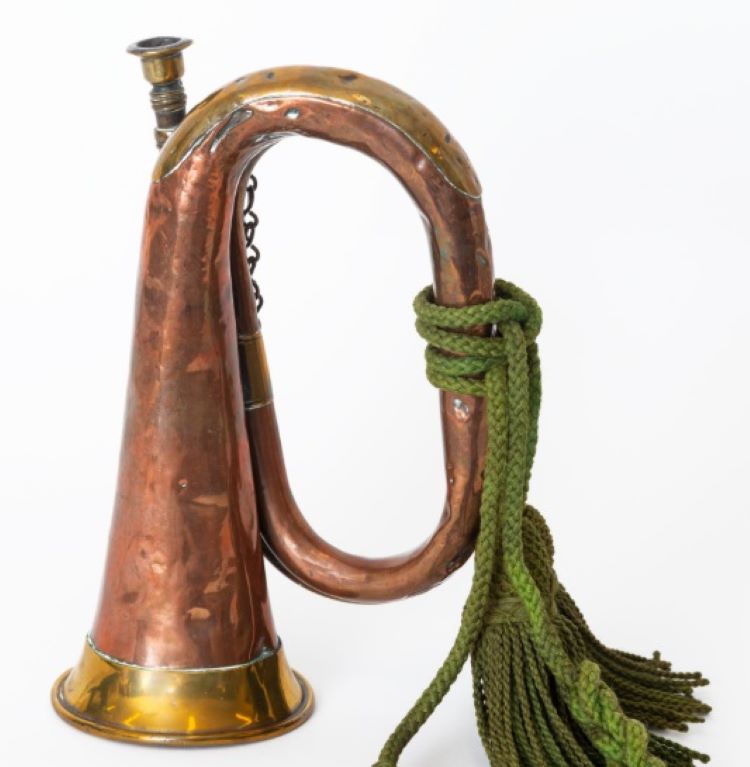
A final tip might be to look in the regimental and local museums for instruments associated with local regiments and volunteers – expecting to find again pipes, drums, and bugles such as the WW1 bugle owned by one “Walter Ritchie” featured at the head of this article. That particular image is from a virtual museum that gathers together images from various smaller collections throughout the Highlands. This is a good idea but it’s frustratingly short in detail (even exactly where the item is located): there is at least an enquiry email for follow up questions. For as long as the funding for the site lasts!
Otherwise, when you visit museums and houses around the country, keep an eye on the display cases for instruments with particular local affiliations. We’ve posted on some of these in earlier posts, from the tin fiddle of Stromness to the family flute of Robert Burns’s home farm. There are many more out there, waiting for you to stumble upon. These instruments have personal histories beyond their generic value.
Further Reading
- Galpin Society for the Study of Musical Instruments website
- Hugh Cheape, Bagpipes: A National Collection of a National Instrument (National Museums of Scotland, 2008)
- Arnold Myers (ed.), Historic Musical Instruments in the Royal Conservatoire of Scotland (with Edwina Smith, Hayato Sugimoto, Lance Whitehead) (Royal Conservatoire of Scotland, June 2025) available print on demand from Lulu books.
- Arnold Myers, (ed)., Historic Musical Instruments in the Edinburgh University Collection (University of Edinburgh, 1997)
- Arnold Myers, ‘The Glen and Ross Collections of Musical Instruments’, in The Galphin Society Journal 38, 1985: 4-8
- St Cecilia’s Hall website (University of Edinburgh collections) website and catalogue and Youtube channel.
- The Highlanders’ Museum, “Walter Ritchie’s Bugle“