

Image: Burns Family Flute display from Ellisland Farm Museum. Please see Further Reading for their site and how to contribute to further restoration work at the Museum.
A recent press release drew attention to James Glencairn Burns, son of Robert, having been a flautist.
His flute, which can be seen at the Ellisland Museum, is typical of pre-modern flutes: made of wood and, apart from 4 metal keys, mostly relying on fingers to stop holes. This one was made by Gerock of London (see the Ellisland website). The Boehm system that later became widespread in the 1840s used more sophisticated metal working technology to open up a much wider range of alternative fingerings, and a wider pitch range; this flute is a less virtuosic instrument, but will have a sweet tone. It has recently been restored thanks to grants from the Pilgrim Trust and Association of Independent Museums; part of a wider programme of works at Ellisland, the Burns family farm.
The restored Burns flute recently enjoyed a short outing to Edinburgh accompanying singer Robyn Stapleton and harpist Wendy Stewart, played by Claire Mann, to songs written by Burns in Ellisland.
Robert Burns himself was a fiddler. Last November (BBC, 2024), another news report celebrated the appearance in public of the 18th century “Gregg” fiddle owned by Robert Burns’s dance teacher and played at the Bachelor’s Club in Tarbolton, at the OVO Hydro, played by Ewen Henderson. That instrument is normally on display in the Robert Burns Birthplace Museum in Alloway. The National Trust website (see Further Reading) has a photograph of it; made of pine, which isn’t necessarily a sweet-sounding wood but a good wood for a dancing fiddle because it gives a bit of bite, it is rather gorgeously decorated with flowers and leaves. Read more about this and other of Burns fiddle connections in the short article ‘Burns and the Fiddle’ on the University of Glasgow Editing Robert Burns for the 21st Century website.
While Burns might have preferred a fiddle, perhaps it’s a shame that he didn’t make more of the flute. As a pastoral (or at least, ploughman) poet, he would have been well aware of the pastoral associations of blown pipes. The design of his son’s German or ‘traverse’ flute became common in the 18th century, not least because it travelled easily in 3 detachable parts, particularly in association with soldiers (see previous Soundyngs posts about early flutes and military music). However, other blown instruments, not including bagpipes, are possible; varieties of end-blown pipes were strongly associated with pastoral poetry and song.
Stock-and-horn
Little played today, the Stock-and-horn comprised a cow horn joined to a cylindrical pipe made of wood or bone and played using a double reed. The sound of at least one reconstructed version is close to a practice chanter: repertoire presumably might be crossover if the holes were in the right place. Sometimes the reed was played directly into the mouth (as for the oboe); sometimes there was a separate mouthpiece (as for the chanter). Few of these hand-made instruments have survived, and although may sound like a chanter, it may not have had anything like standardised tuning. The cow horn at the end helped to amplify the sound. The parts could be easily assembled in the field by herders wanting a pastime while their flocks grazed, although one suspects they were more often made of an evening at home.
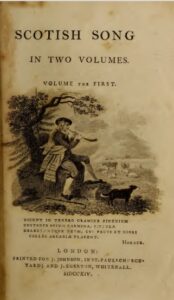
Figure 1: frontpage image from Ritson’s Essay on Scotish Song Vol. 1 (London: 1794)
Contemporary 18th century illustrations make a case for this now extinct instrument being strongly present in Scottish indigenous tradition in the 18th century: see, for example, the title page of Ritson’s Essay on Scotish Song (1794) (see Figure 1 above). Robert Burns wrote in a letter of 19th November 1794 that he had had acquired one (see Langwill, p.173) from a source at the Braes of Athole.
The 18th century literary interest in pastoral, a mode of writing found also in ancient Rome, reflected a sense that virtue was to be found in simple country lives, away from the temptations of courts or cities more generally; pipes were part of the musical apparatus of pastoral, played by idealised rustics. Allan Ramsay’s popular pastoral play, The Gentle Shepherd (Edinburgh, 1725), was published in many editions throughout the century, and may well have increased popular awareness of the stock and horn, if not necessarily playing uptake. In scene 1 of that play, the shepherd Roger – who is later revealed to be a nobleman in disguise – complains that the girl he loves, Jenny, is unmoved by his serenading her on stock and horn:
“When I begin to tune my stock an horn,
Wi a’ her face she shaws a cauldrife scorn.”
His friend, Patie, a true shepherd, has better luck wooing, playing his pipe while his girl, Peggy, “sings sae saftly”.
Burns referred, in a 1794 letter to Alexander Cunningham, to David (son of Allan) Ramsay’s engraving to a 1788 edition of The Gentle Shepherd, considering this instrument as a possible adornment to an imagined heraldic coat of arms he wished to have designed for himself: “by the shepherd’s pipe and crook, I do not mean the nonsense of Painters of Arcadia; but a Stock-and-Horn and a Club; such as you see at the head of Allan Ramsay in Allan’s quarto edition of the Gentle Shepherd” (Langwill, p.177). In due course, the stock-and-horn Burns obtained apparently had a sheep thigh bone as the pipe stock, and might well have been better hung over the fireplace (or placed into it) than played. Burns admitted to George Thomson that either the holes were badly bored or else he was inept, because “we can make little of it”. Thomson’s reply was “I doubt much if it was capable of anything but routing and roaring” (Langwill, p,.178).
Do read more of Langwill, whose article includes several illustrations of the instrument in its variant forms, including (p.179) a suggestion that it might be the same instrument as the ‘corne pipe’ in the list of shepherds’ instruments played in the Complaynt of Scotland (1548).
The stock and horn pastoral trope was popular well into the lifetime of Burns son, owner of the more mellifluous flute. The Scottish painter Sir David Wilkie returned to the theme in 1823, with an oil painting of the Gentle Shepherd Roger playing a stock and horn to two girls – one presumably Jenny clearly sneering – and a less than impressed sheepdog (see ‘National Galleries’).
Whistles
Robert Burns’ lyric ‘Oh, whistle and I’ll come to you, my lad’ (1787) almost certainly refers to mouth whistling rather than an instrumental whistle. The tune was composed by John Bruce, a Highland fiddler and Jacobite, who lived in Dumfries in later life. Burns wrote words for this melody – a shorter version in 1787, which appeared in Johnson’s Scots Musical Museum, and later another 2 verses. Clearly the whistler in the song is having more luck with the girls than Roger enjoyed with his stock and horn; but when did the ‘whistle’ associated with folk music today, the penny whistle, start to be common in traditional music circles?
Simple ‘duct flutes’ (end-blown pipes which have a partially blocked head and a sharp edge that splits the air flow) are common the world over, often made from hollow bone, found in ancient archaeological sites. The French and German ‘flageolet’ is a refinement on this basic design, referenced in medieval texts as a pastoral instrument, a reputation that carried into the early modern period. A sparsity of holes, along with a slightly conical bore, distinguishes it from the recorder or flûte à bec.
According to Norman Dannatt, the metal tin- or penny-whistle was invented by a Suffolk farm worker called Robert Clarke who adapted the older flageolet type instrument, from 1843 selling these from a barrow (Dannatt). Successful sales saw him move operations to England’s industrial north-west, where they became particularly popular when exported to Ireland, probably helped by the 19th century movement between Ireland and Manchester of Irish labourers.

Figure 2: Clarke’s original Meg whistle, still on sale today
I remember having a Clarke penny whistle at a young age: as Ford might say, it came in any colour as long as it was black with gold lettering. The stop in the mouthpiece was wooden and became quite soggy if played for any length of time (unlike modern plastic variants). The original design had, and still has, 6 finger holes, no thumb hole, and hence quite restricted chromatic options and pitch range. Higher octaves can be achieved by overblowing, up to and including sheepdog pain thresholds. If you want to play in different keys, you need different sizes of whistles – although D is a useful standard to play with fiddles.
Presumably, whistles moved from Manchester north to Scotland; however, it is also probably the case that the generic ‘Gaelic’ sound associated with Irish music gained international popularity and hence influenced Scottish folk music. Not such an indigenous instrument, then. Clarke’s today also sell harmonicas, kazoos, and fifes: all good choices to get a tune across in a noisy pub. Perhaps the stock-and-horn is due a come-back; if not necessarily as an aid to courting, to give the whistle some competition in more robust performance contexts.
Further Reading
- Anon, A Scene from Ramsay’s ‘The Gentle Shepherd’, National Galleries, accessed 19 August 2025. Describing David Ramsay’s illustration and his father’s play.
- Anon, ‘Burns Family Flute Played After 150 Years’, Ellisland Farm Museum, 13 August 2025.
- Anon, ‘Fiddle Linked to Robert Burns to be used at gigs’, BBC News, 12 November 2024.
- Anon, ‘Whistle and I’ll come to you my lad’, from The Traditional Tune Archive
- Norman Dannatt, ‘Pennywhistle [tin whistle]’. Grove Music Online, 2001, accessed 19 August 2025.
- Lyndesay G. Langwill, ‘The Stock-and-Horn’ | Proceedings of the Society of Antiquaries of Scotland 86 (1952), pp.173-180, https://doi.org/10.9750/PSAS.084.173.180
- Kirsteen McCue, ‘Burns and the Fiddle’, Editing Burns for the 21st Century, University of Glasgow, accessed 19 August 2025
- Pauline McLean, ‘Robert Burns Family Flute Restored and Played Again after 150 Years‘, BBC News 13 August 2025 (updated 14 August 2025)
Websites
- Clark Tinwhistle Company website
- Robert Burns Ellisland Museum & Farm (The Home of Auld Lang Syne) website – including information about how to support this privately run museum.
- Peter Walker playing the Scottish Stock and Horn – his own channel on Youtube