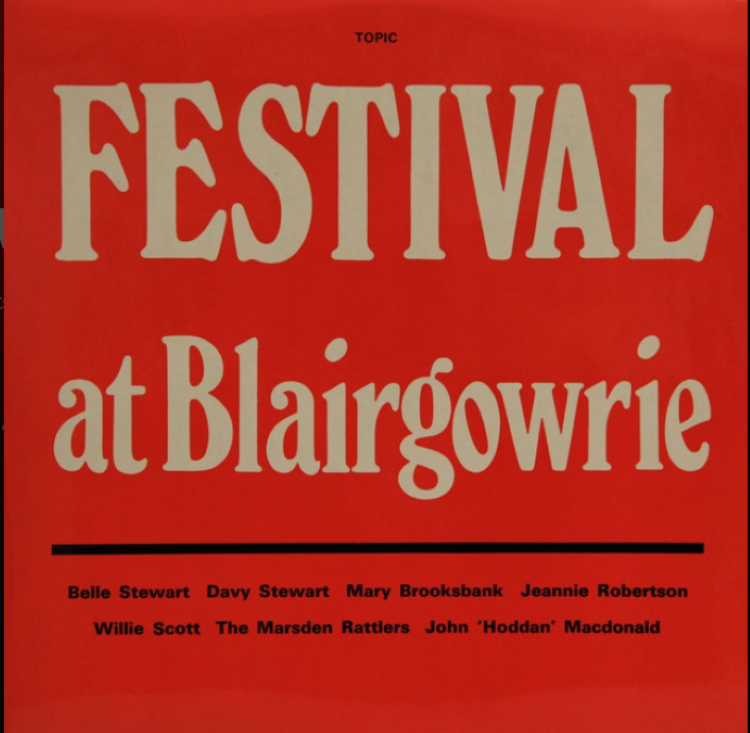
Image: Festival at Blairgowrie (Topic Records, Topic 12T181, 1967), recorded by Pete Shepheard.
An interview with Pete Shepheard held on the Tobar an Dualchais website (see Pete Shepheard, n.d.) suggests (07:15 into the track) that the Crieff Folk Festival, run by Archie Gibson, was the first ‘folk’ festival in Scotland … although perhaps Hamish Henderson might have seeded something in Edinburgh a bit earlier.
Interviewing Pete in Fife in October 2025 added more information to what I knew about the early folk festivals in East Coast Scotland.
As Pete remembers it, the inspiration for starting up more folk festivals in Scotland came from Ireland. He recalls Archie Fisher (the Glaswegian singer who lived in Edinburgh in the 1960s and who was a regular at ‘The Howff’ folk club in Dunfermline) becoming interested in Irish music thanks to his dating, for a while, an Irish woman. Archie Fisher was one of the founders of the Edinburgh Folk Festival in 1964, inspired by a 1963 trip to the County Claire Fleadh. His death on 1st November 2025 was lamented by many in the Scottish folk-scene (see BBC, 2/11/25, below).
Learning from Archie that traditional music, learned orally, was a strong feature in Irish communities inspired Pete Shepheard and his St Andrews friends to go to the Fleadh Cheoil in County Clare in summer 1964, where they encountered bands such as The Dubliners, and talked to people about how to run a folk festival.
Inspired, the St Andrews group set about finding a suitable place to run a festival in Scotland, and in 1966, two years after the Edinburgh Folk Festival, the first Blairgowrie Folk Festival took place, focusing particularly on the older songs that had been preserved in the berry-picking traveller community recorded by the Edinburgh School of Scottish Studies.

Figure 1: Programme from the first Blairgowrie Festival in 1966, with thanks to Margaret Bennett for sending me this from her files
The first line-up included bothy ballad singers such as Jimmy MacBeath, the local traveller Stewart family, and Aberdeen ballad singer Jeannie Robertson.
Blairgowrie had long been familiar with the traveller community as seasonal soft fruit farm labour, but the Festival allowed them to be seen locally in a new light. Pete remarked that Blairgowrie also had hotels used to accommodating people returning late from the Braemar games, and which therefore had late licenses for live music and bars to co-exist. On this foundation a successful folk festival could be built.
The Blairgowrie Festival was another ‘node’ in an expanding folk scene. To keep momentum going, later the same year saw the founding of the Traditional Music and Song Association of Scotland (1966-7), with Pete as one of the founding members. The mission of the TMSA is to make sure that no performer could say ‘I am the last’ – to run festivals, sessions, workshops and competitions dedicated to passing on the oral tradition to new generations of singers.
With the assistance of the TMSA, a recording was made of the 1967 festival, with notes by Pete Shepheard. The LP sleeve contents list (see figure 1, above) lists songs, singers, and bands from the period singing in Gaelic, Scots and standard English, with songs reflecting both Scottish and wider UK folk traditions.
The 1967 Blairgowrie Folk festival also gave an early opportunity to Shetland fiddler Aly Bain, on his first ever trip away from Shetland, to play his reels to folk doon sooth – the opening notes of a long and illustrious career at the apex of Scottish folk music. Bain doesn’t feature on the LP, but made an impression on Shepheard’s memory of the festival that year, and became a regular guest at TMSA festivals over many subsequent years.
In due course, Blairgowrie spawned a successor – the Kinross Festival – which also featured competitions supported by the TMSA, with judges including names such as the famed leader of Shetland’s ‘Forty Fiddlers’, Aly Bain’s teacher Tom Anderson.
Shepheard is interesting on the subject of these festival-based competitions. While other traditional music organisations were tending to develop quite rigid repertoire and style requirements which aimed to preserve musical tradition more or less unchanged, the TMSA acknowledged that traditions might evolve by allowing competitors greater lea-way in choice of pieces to perform. This element of repertoire choice also allowed local styles to ‘come through’ which weren’t necessarily mainstream, permitting variety in musical evolution – a living tradition was being expressed. That the competitions sat within performance-led events might have helped this focus; entertainment sat alongside tradition-bearing.
Meanwhile, finishing his doctoral thesis in St Andrews, Fife meant looking further afield for work, and in 1969, Pete Shepheard left Scotland for a couple of years, travelling to the different town of St Andrews, New Brunswick, Canada, where he was to study lobsters in a research base concerned about the pending collapse of the Newfoundland fisheries. Music, however, was still a major interest, and he seized the opportunity to hear Aly Bain perform for the folklorist Sandy (Edward D) Ives the the University of Maine in Orono. Nearer his home in northern New Brunswick, he also encountered the well-established Miramichi Festival, the longest-running Canadian folk festival and possibly one of the oldest anywhere, founded in 1948 by folklore enthusiast Louise Manny.
The back story of Miramichi is most curious. Newspaper baron Lord Beaverbrook was raised in the town, and had asked Manny to collect songs from his childhood home – songs about fishing and logging, with musical influences reflecting the Irish and French heritage of many local inhabitants. Manny’s collecting methods including running ‘times’ – a Newfoundland word for a ceilidh gathering at a private house – at which songs might be sung and stories told. This was a tough environment in which to work; folk songs that reflected the conditions of life in this northern place included songs about lumberjacks falling into log jams on rivers and being crushed, as well as more companionable backwoods stories.
One aspect of this Canadian folk culture that particularly inspired Pete Shepheard was the cheaply produced local recordings – sold in LP format – of local fiddlers, playing live music, circulating in parallel with local television and radio shows, widening the reach of local fiddlers and musicians such as the Newfoundland melodeon player Harry Hibs (1942-1989).
Returning to Scotland, Shepheard decided to take these Canadian examples of recorded traditional music into a new venture, founding a record company, Springthyme records, to be discussed in the next post.
As a final note on Festivals, Pete has been involved with other Scottish folk festivals – particularly Auchtermuchy festival and latterly the FifeSing Traditional Singing Festival. He says that folk musicians mostly don’t make a lot of money from their art, but these sociable occasions go a long way to making a living tradition possible through sharing traditional music in sociable contexts.
Linked posts:
[Pete Shepheard remembers St Andrews Folk Clubs]
[Pete Shepheard remembers Springthyme Records due 2/2/26]
Further Reading and listening
- Pete Shepheard, ‘Fife Folk Clubs, Folksingers and Festivals’, recorded by Stephanie Perrin Smith for the Tobar an Dualchais archives at the School of Scottish Studies, University of Edinburgh (n.d.)
- TMSA (Traditional Music & Song Association of Scotland) homesite
- ‘Folk Musician and BBC Presenter Archie Fisher Dies, Aged 86‘, BBC 2 November 2025