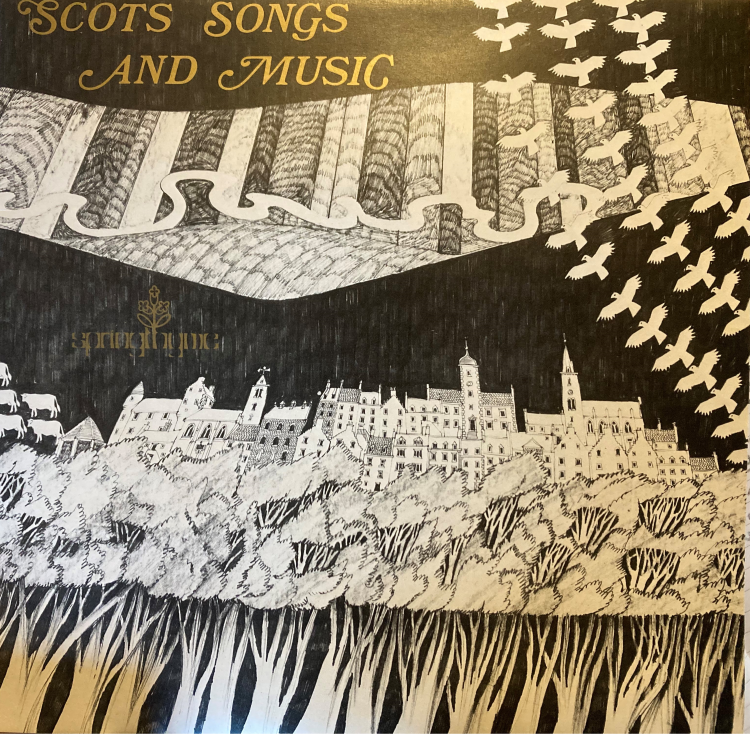
Image: Scots Songs and Music Recorded at the Kinross Festival of Traditional Music and Song (Springthyme Records SPR/SPRC 1001 LP, 1973)
This is the third of 3 linked posts with information from Pete Shepheard about the folk revival and its songs.
Pete Shepheard had encountered traditional music independent record companies in Canada, but, apart from one outfit dedicated to Gaelic song, while Ireland had developed this infrastructure (e.g. Claddagh Records, founded in 1959), Scots-language song had no equivalent in the early 1970s.
In 1972, Pete Shepheard set out to change that. Now living in Glasgow and working for the University of Glasgow, he opened discussions with a local indie music production company GRF about setting up a label for Scottish folk music.
Pete says he hadn’t realised was that GRF was a Gospel / Christian label. Notwithstanding that curious misalignment of musical interests and evangelical goals, their expertise was clearly helpful to the fledgling record producer.
By this point, the original Blairgowrie Festival operation had shifted focus to Kinross, sitting on the A9 with good connections to all points of the compass. With GRF’s guidance Pete was able to record the Kinross Festival in 1973, and an album appeared which was the first of a new operation – Springthyme Records.
See Springthymes’s own website for a full listing of outputs: you’ll see that this covers both records and books about music. The website is a rich source for both song lyrics and back stories.
Highlights in Springthyme’s catalogue include Shores of the Forth (1974), featuring John Watt and Davy Stewart, regulars at the Dunfermline Folk Club, which Pete says was their most successful record of all time. Conceptually, this was inspired – he says – by the ‘concept album’ popularised by the Beatles: a group of songs not simply randomly chosen but tied together by a story or journey around – in this case – a particular locality.
Another popular album features The Foundry Bar Band (1981), a group normally to be found in their local pub, the ‘Foondry’ (as it was termed) in Arbroath. Members included Jim Reid, legendary singer, songwriter and moothie player. This went well into 5 figure sales, thanks to advertising on Grampian TV. Local customers were buying into music that reflected their own sense of local musical identity. The folk club concept, if you like, had gone large thanks to recording technology.
Pete talked about what the ‘Foundry Bar’ actually was: a festival bar, using a barn usually used to store potatoes, which had to be cleaned by fire hoses before the ceilidh could take place. The air was rich with dust when the feet started to stomp.
Jim Reid’s Wild Geese album of songs (1984) is another rich collection to check out.
Pete Shepheard has a research doctorate, and he brought that eye for meticulous detail to this recording work. An example of this is the collection of Scottish borders fiddle music played by Tom Hughes, first issued by Springthyme in 1981 on vinyl – with extensive sleeve notes – and then added to by an extended book and CD in 2015. Soundyngs has remarked before about the leanness of contextual information on modern streaming services, and this project provides a good example of why older media still matters. Transcribing tunes himself firstly using a music typewriter for the original LP, Shepheard has produced not only recordings but also, now, books of tunes (now set using digital software) to assist those wanting to play this material themselves.
Tom Hughes (1907-1986) was a ploughman from a farming community around Jedburgh, and learnt his music orally from family members, getting his first fiddle, made by his grandfather, as his Christmas aged 7. With his father, he travelled to play at dances, hiring fairs and ceilidhs, and as an adult he was well known both as a solo performer and also with his bands, the Kalewater Band and the Rulewater band, through the 1950s to the 1970s.
Pete Shepheard realised that many of Hughes tunes were unique to the borders: tunes such as the Kelso Hiring Fair, and The Morpeth Rant. In conversation with us, Pete demonstrated how the ornament and upbeat to The Morpeth Rant relates to a wee cross step in the dance choreography: the music and the movement are one. This was the repertoire recorded by Pete at Springthyme records, along with transcriptions which preserve bowing marks and ornament instructions, as close to the original as could be achieved, and also comprehensive notes from interviews with Hughes providing the background stories to the tunes. Not all the tunes are local to the borders: Hughes learned many others, including music-hall favourites such as ‘Champagne Charlie’ and Shetland numbers picked up from players such as Aly Bain and Tom Anderson, familiar guests at the Kinross Folk Festival back in the 1970s. The recording sessions were made in Bedrule village hall, convenient to Hughes.
As a traditional musician himself, playing guitar and box accordion, Pete is a sterling guide to this material, which constitute an alternative ‘oral’ teaching resource to those not lucky enough to have tradition bearers in their own immediate family.
Linked posts
[Pete Shepheard remembers the St Andrews Folk Club]
[Pete Shepheard remembers Folk Festivals and the TMSA]
Search ‘Shepheard’ on Soundyngs to find also a review of Shepheard’s songbook and biography of bothy ballad singer Jock Duncan.
Further Reading and Listening
- Anon, ‘Pete Shepheard: Scottish Traditional Hall of Fame’, biopic, Hands Up for Trad (n.d.)
- Fife Sings Bandcamp page
- Iain Fraser, ‘Recording Review: Traditional Fiddle Music of the Scottish Borders, from the Playing of Tom Hughes of Jedburgh” in Folk Music Journal 11(2), 2017, 91-93
- Tom Hughes, ‘Traditional Fiddle Music of the Scottish Borders (Cupar, Springthyme CD SPRCD 1044, 2015) from Tom Hughes and his Border Fiddle (Balmalcolm Fife, Springthyme Records vinyl SPR 1005, 1981)
- Peter Shepheard, Traditional Fiddle Music of the Scottish Borders from the playing of Tom Hughes of Jedburgh (Balmalcolm, Springthyme Records, 2015) – the book behind the recording, tunes and their stories, accompanying the CD
- Peter Shepheard, Spiers and Watson Bandcamp page
- Springthyme Records webpage– with links to back catalogue, bandcamp tracks, books and much more, including lyrics and their background stories.
- Springthyme Bandcamp page – follow this for early notice of future recordings