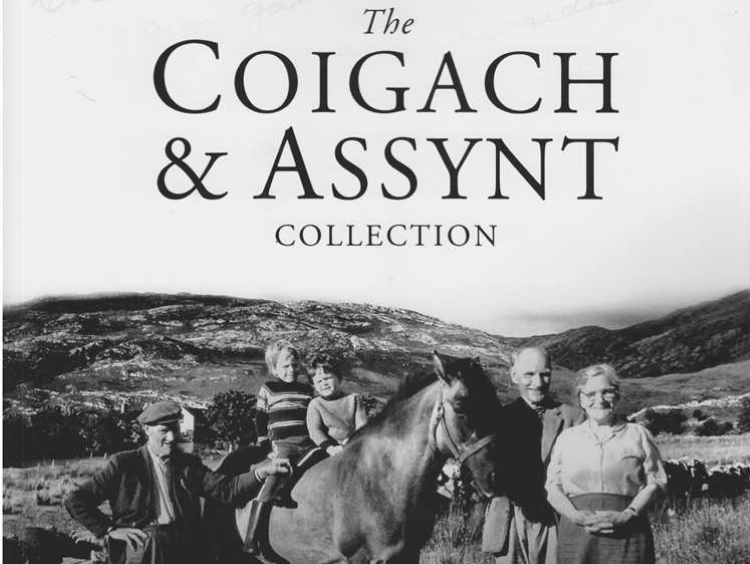
Music, place, and people are woven together in this collection from the far north-west of Scotland.
Subtitled ‘òrain, sgeulachdan, puirt’ (songs, tales, tunes) the book is a community-led project that explored how people’s relationships with the land were, and clearly still are, experienced.
Sold primarily as a wire spiral-bound publication, this would work as a session book and not just a resource for those interested in music heritage and tradition bearing. What caught my attention here was that this is not only a collection of older material and memories, but also reflects how these – and the collecting project itself – were used to inspire new song composition and reflect on ongoing practices of tradition bearing. It is also, if not quite as cheap as chips, then at least as cheap as a fish supper with mayo, ketchup, mushy peas and an ice-cream tub from my local chippie.
Led by the Coigach Community Development Company, this is part of a vision to support the growth and thriving life of one of Scotland’s most beautiful remote places. CCDC runs a local wind turbine and hydro-electric scheme, generating a bit of profit that funds local development work. And so, this isn’t just a book. If I were playing a kind of musical charades, I’d need a gesture for book, composition, workshop, event, film etc. Because clearly making the book was accompanied by a lot of other activity (see the report from the project). A lot of this happened in the Covid year of 2020 lockdown, so well done to everyone for pushing through that dark year.
To the book itself, whose contents include tunes old and new, Gaelic lyrics and translations, notes giving the back stories, and archival photographs. The book’s editor, musician and designer Ronan Martin, has produced an elegant product with easy-to-read material: notes are not too small to read in low light, usefully for pub sessions.
Lots of local and near-local folk had a hand in making this. A foreword by (then) local music teacher Valerie Bryan, who was also clearly involved in the larger programme of events, name checks a lot of other local people who passed songs and pipe tunes down to others in their community. Anne Marie Firth-Bernard, the project coordinator overall, goes on to provide an overview of the regional context and how the project came into being. And Skye-based Ronan himself writes a second introduction about his musical connections with the north-west mainland: lots of names listed in that section invoke a community project with a lot of collaborative input.
Contributors also include some well-known names from the wider world of Scottish contemporary folk music and media. As publishing (and publicity) is inevitably enhanced by ‘big name’ involvement, popular Scottish journalist Lorraine Kelly was involved with initial interviews (see Music & Tales of Coigach & Assynt, below) which provided the initial inspiration for the project. Lorraine Kelly is warm and charismatic, although she is not from Assynt of Coigach: she’s Glasgow born, and has lived in various places including Perthshire and Dundee but never Assynt or Coigach (i.e. not a technical Gael). However, with a long career in Scottish broadcasting and a large and affectionate following, she was rather an inspired choice to provide an additional kick of popular reach-out, which must have assisted with subsequent fund-raising and dissemination. Well-known Gaelic-language folk singer Mary Ann Kennedy (also born in Glasgow) has also been working in parallel the book with Nick Turner, Finlay Wells, and Donald Maclean, to compose a new album of material inspired by the project.
The point is, I think, that the music of this beautiful but remote area can poke the imagination of people further afield to think about how their own geographies might be reflected in songs, stories and tunes. A project, and a publication, provide a slow-burning gathering place: if not a synchronous ceilidh, then an asynchronous centre to a ripple effect.
Funding reflects a range of sources – public (like the National Lottery Heritage Fund, through the Scottish Wildlife Trust), community-based (the Coigach Community Development Company) and private (like the Garfield Weston foundation. And the KMF Maxwell Stuart Charitable Trust). Well done to the project managers for juggling all this.
Section 1 – òrain is dàin (songs and poetry) – comprises 21 songs, with topics ranging from fishing, weddings, and particular places. If you are the kind of singer who tells the story then sings the song, the information is all here for you, although not always unfolding entirely transparently, particularly where a song has had many hands in it. One example of this complete-yet-mildly-opaque information set is the song of exile “Cur Cùlaidh ri Asainte’ (Fairwell to Assynt). The lyric is attributed to Alexander MacLeod of Culkein (1912) who left for Canada in that year (see p.12). The note immediately below the tune attributes this to the singing of James Graham, and the Gaelic transcription to Mary (later, spelled Màiri) MacLeod of Culkein; the copyright is then ascribed to to Màiri MacRae (maybe born MacLeond?), then again the melody to John Macleod of Culkein; finally, the note to the lyric points out that ‘some verses have been added by others and some of the original verses have been lost’ – what remains is convincing and – at least to this outsider – feels like real community work, communally owned, made and reproduced, even if I wasn’t entirely sure whose bit was which.
A recurring theme throughout all sections is the Canadian connection, with awareness of the long term impact of the clearances and realities of economic migration: songs of farewell often include verses composed in Canada by emigrants trying hard to remember, and preserve in song, what was left behind in Scotland.
The Macleods of Culkein, however they are spelled, are a significant local presence. Poet John Macleod of Culkein, locally called the Professor, was a lecturer in English literature and his anthology Dàin agus Òrain (Poems and Songs) (1900, 1918) was clearly an important moment when literary (new) composition fed new words into local song making. While traditional song transmission may be oral, it’s important to acknowledge – as the collection does – that the Gaels of this region were also a highly literate people.
And songs continue to be made. Absolutely convincing to anyone raised in the far north are songs of big storms, capable of lifting houses – see ‘Rèidhphort’ (p.34), a new song made by Eilidh Mackenzie in 2009. Traditional melodic gestures, such as the piper’s grace-note upper-to-lower ‘cut’, are incorporated into new songs, such as Mairearad Green’s ‘Star of Hope’, a boat from Orkney that used to trade with the Achiltibuie shop (p.36-7).
Section 2 – sgeulachdan is dealbhan (tales and photographs) – opens with a quote by accordionist Mairearad Green linking the land with the music: “so much of the music and the language, it comes from the land. I’m a painter as well, so the visual inspiration is massive to what it is that I do. And when you grow up with these kind of views on your doorstep, and if you start learning the place names, they are all related to the land and the language and that’s all part of the rhythms within the music” (p.44). So – placenames, their rhythms and assonance, inspire music.
Crofting, fishing, Travellers, trade (steamers and shops), music competitions (local mòds), sessions, and again, emigration, are all featured in this section, with picture images naming and locating the people in their places.
Section 3 – puirt (tunes) is listed by genre (jigs, marches, airs, reels, etc). Many of these are recent tunes, with the composers telling us why they were made. A name to conjure with here is Ali ‘Beag’ MacLeod, box accordion player, whose strathspey ‘You Can’t Play a House’ (p.69) comes with the story of his first button box, bought with his wages from salmon fishing. It cost a lot, and a friend commented he might have got a house for the same money – hence, ‘you can’t play a house’. Which is true, although houses and homes clearly inspire music.
In this section, ‘Leaving Stoer’ (p.71) by Ivan Drever is probably the best known tune in the book, widely known even outside of the north-west, composed in 1997 out of the composer’s collaboration with well-known Inverness-born fiddler Duncan Chisholm.
The final set of tunes are for pipes, with input from folks like Gary Nimmo, a recent school piping instructor in Wester Ross, whose tune ‘Euan MacRae of Drumbeg’ remembers a former pupil whose early death deserved a commemoration (p.85).
And that’s what music does: help you remember, and cherish, places and people.
This is, apparently, the ‘first’ book in the collection. Keep an eye out for more like it.
Further Reading
- The Coigach & Assynt Collection: Òrain, Sgeulachlan, Puirt (Songs, Tales, Stories), compiled and edited by Ronan Martin (Skye, Gaigh Na Teud / Scotlands Music, 2021) – see either the Coigach community project or the publisher website.
- ‘Music & Tales of Coigach & Assynt’, part of the website for the Coigach & Assynt Living Landscape project – with a link to the report showing the uptake of the book and launch events.
- Coigach & Assynt Living Landscape Parnership, The Soil Beneath Our Feet (2018), featuring Anna Buxton (fiddle/voice), Kim MacLennan (accordion), Rory Matheson (piano), assisted by Mairearad Green and engineered by Joseph Peach – local young musicians
- Marearad Green, musician and artist, website
- Mary Ann Kennedy, Finlay Wells, Nick Turner, Donald MacLean, Talamh Bèo, for Coigach & Assynt Living Landscape (2022)